One of the curious things about getting older is that pleasure is derived from things your younger self simply wouldn’t appreciate. Fifteen years ago, the formative me would be enthralled by the prospect of a Butthole Surfers tour or an unattended crate of brown ale, while the older me likes nothing more than to purchase something shiny and gleaming for the kitchen, and is seldom happier than when scanning the Sunday supplements for new and exciting recipes. Recipes like Hugh Fearnley-Whittingstall’s Lamb In Hay, where seventeenth century French tradition meets pretentious middle-class culinary experimentation in a friendly, made-for-TV package.
Apart from being something of a fire-risk, which is exciting, there are no obvious reasons to bake a leg of lamb in hay, apart from the fact that it’s a talking point in itself. There are many other ways to prepare the meat, all of which are satisfactory and require neither a trip to the pet shop nor a cooking process that makes your kitchen smell like a overly damp barn. Nonetheless, it’s what I conjured up for my dinner guests yesterday, and I feel duty-bound to report my findings.
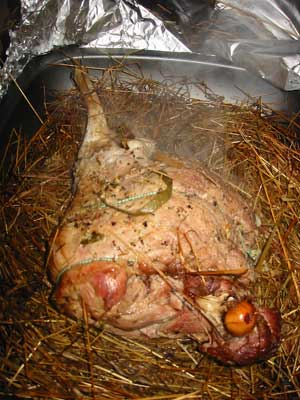
And there it is. The top layer of hay has been removed to reveal the succulent flesh beneath and, by golly, it is tender, a genuine melt-in-the-mouth sensation. The only problem is the flavour. The meat is delicious but it tastes, perhaps unsurprisingly, of hay. Lots of hay. This would be fine were I a horse or a guinea pig, but for human beings the sensation is somewhat unsettling. So why would anyone cook using this method? I can only assume that the meat French peasants were using four hundred years ago was so overwhelmingly rancid that this process was necessary to disguise the fetid nature of the food, much like chili sauce on the modern-day kebab.
And Hugh Fearnley-Whittingstall? Don’t believe a fucking word he says.
I am so glad you tried this so we don’t have to. Hugh F-W is often very good, when not offering mental recipes for 30 guests, but this smacks of a man looking at a big pile of hay and a joint of meat and wondering what to with them. Our Easter legga lamb (Agnus! Agnus!) was marinaded in a carrier bag full of Nigella Lawson’s suggestions, but I was not involved. I can’t read her recipes. They’re idiotically digressive. Have you ever tried any of Heston Blumenthal’s wilder methods? Do they work? I can see that they would, scientifically like, but I just can’t be arsed.
I haven’t tried to reproduce any of Heston’s gastronomic alchemy, but I shall. And then I shall write about it here.
Have you tried subscribing to Heston Blumenthal’s newsletter?
I did and only ever received one, but it was completely loopy. Well worth it.
Are people still solemnly still repeating the old Victorian canard that medieval and Renaissance meat was always rancid, and thus needed to be highly spiced?! Next they’ll be telling us to “moisten” sandwich bread with butter or mayonaise, or to sear meat “to seal in the juices”. Seriously, highly-spiced rancid meat would have tasted like just that, and no one, no matter how hungry, would have eaten it.
As for Lamb in Hay, I suspect it works best with tasty, aromatic fresh hay or fresh herbs, rather than ordinary farm-fodder. I’d like to try it with rosemary twigs.
If you look at medievil recipes, you often find that meats were marinaded, this wasn’t to disguise the flavour of bad meat, but because meat couldn’t be kept for long as they had no way to keep it (I shan’t digress into pickling, salting or smoking here, we’re talking fresh meat), meat would often be a little tough, a good marinade would soften the meat prior to cooking.
Maybe you didn’t blacken the hay enough?
In his recipe HFW describes scraping away the blackened hay.
From the photo above, your hay still looks quite golden which is possibly why the very hayey taste persisted?
Torch the fucker next time!
“Torch the fucker next time!”
LOL!
That’s one way!! :)
Man Alive! Just took a really good look at that picture of the offending item, above. It looks revolting! What a waste of a sheeps’ leg. I hope the rest of it was also hacked up, minced, kebab-ed and not wasted on such an ugly recipe.
Hi
I’m french and I never heard anything like cooking stuff in hay!! Yuck.
Poor Hugh must have been fooled by some mischievous old farmer! ;-)
Excellent work with your pork pie, though.
Urgh, looks like a still-born lamb, still steaming away in the barn
The mistake might have been in the hay you got from the local pet shop…? I saw this recipe once on BBC Food and Drink (the lamb and hay braised/simmered for a long time in water), and the idea is that the sweetness from the (fresh) hay goes into the meat…
Yep, I think was completely my mistake ;-)
seal the meat well, get the caramelisation…… place the hay into a pot large enough to hold the joint, heat the pan to get a good smoke coming from the vegetation, place the lamb on top,taking care to ensure any juices from the meat does not stop the hay from smoking, cover tightly and cook in a moderate oven till the required “doneness” is arrived at. i think it is important to think of this as a smoking technique to impart flavour to the meat, not a wet cooking technique that will tenderise an otherwise already tender cut…. works at the restaurant i work at anyway.